The US hopes that the differences will be resolved peacefully, officials said in Washington.

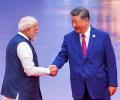
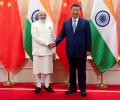
Prime Minister Narendra Modi conveyed to Chinese President Xi Jinping that peace and tranquillity along the frontier remains an "essential" basis for the development of India-China relations, even as the two leaders welcomed "steady progress" in bilateral ties during their talks on the sidelines of the BRICS summit.

National Security Adviser Ajit Doval held "constructive" talks with Chinese Foreign Minister Wang Yi in New Delhi, focusing on the normalisation of bilateral ties. The discussions reviewed recent developments and progress towards rebuilding trust after the eastern Ladakh border standoff. Both sides have implemented measures, including disengagement pacts and high-level meetings, to improve relations.

National Security Advisor Ajit Doval is in Beijing for the 25th round of Special Representatives talks on the India-China boundary issue with his Chinese counterpart Wang Yi. These crucial discussions precede Chinese President Xi Jinping's anticipated visit to India for the BRICS summit, offering a potential opportunity for a meeting with Prime Minister Narendra Modi. The talks aim to address the long-standing border dispute and recurring tensions, with both sides emphasising the importance of peace and tranquillity for bilateral relations amidst recent reports of aggressive Chinese posturing in Arunachal Pradesh.

'We are open to all countries around the world as long as we get a fair deal, as long as we are ensured continuity in the engagement.'

China has declared India's move to identify 27 places in Arunachal Pradesh by their standard names as "illegal, null and void," reiterating its claim over the region it calls Zangnan. India has consistently rejected China's renaming attempts, asserting Arunachal Pradesh as an integral part of India.
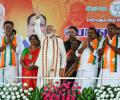
The prime minister should apologise to the 140 crore Indians for deceiving them on national television on June 19th, 2020, with his statement Na Koi Ghusa Hai, Na Hi Koi Ghus Aaya hai

The recent reports of incursions and firing along the India-China border has not deterred spirited tourists who have begun thronging the Buddhist monastry town of Tawang in Arunachal Pradesh, over which China stakes claim.
'When the Galwan incident took place, that was a big break in the trust factor between India and China.'

Chinese Foreign Minister Qin Gang reiterated that the situation at the India-China border is generally stable and both sides should consolidate the present achievements and strictly abide by the relevant agreements while pushing for further cooling and easing of the conditions for sustainable peace and tranquillity at the frontier.

The Indo-Tibetan Border Police (ITBP) is undergoing a significant modernization drive, establishing drone platoons, developing a new 'Strike' course for Galwan-like situations, and constructing underground infrastructure along the Line of Actual Control. This strategic shift, announced by DG Shatrujeet Singh Kapoor, aims to counter China, identified as India's 'biggest adversary,' by embracing modern warfare techniques learned from recent global conflicts.

'The Chinese military cannot advance much in Ladakh, even if they want to.' 'Similarly, in Arunachal Pradesh, they can rename a village or two, intrude here or there, but cannot do much more realistically.'

Prime Minister Narendra Modi has announced a significant 24,000 crore Nepalese rupees development package for Nepal, further solidifying bilateral ties and launching key India-assisted projects, including a new cross-border passenger rail link between Ayodhya and Janakpur Dham. This move signals a major reset in relations after a period of strain over border disputes, with both leaders emphasising deep kinship and mutual support.

An Indonesian woman was arrested at the India-Nepal border in Maharajganj for allegedly concealing her nationality and fraudulently obtaining Indian identity documents like voter ID, Aadhaar, and PAN cards. She was living under a fake name, 'Lee Kim Lian', since 2005, despite her Indonesian passport identifying her as 'Rohana'. Investigations revealed extensive international travel and associations with a Buddhist centre in Kolkata.

The Congress has criticised Prime Minister Narendra Modi for his "deafening silence" regarding reported face-offs with the Chinese Army in Arunachal Pradesh.

Nepal Prime Minister Balendra Shah is on a two-day visit to India, focusing on energy, economic cooperation, and infrastructure development. This marks his first official bilateral foreign visit since taking office. Discussions will cover expanding connectivity, trade, and investment, with several MoUs expected to be exchanged. The visit aims to strengthen the deep-rooted ties between the two nations.

The Chinese side is said to have called off the 15th round of the talks between Special Representatives (SR) of both the sides after India refused to accept their demand that the congregation which was to be addressed by the Tibetan spiritual leader be called off.

Pakistan is currently deliberating its participation in the Shanghai Cooperation Organisation's Civilisational Dialogue Forum, scheduled to be held in India later this month. The invitation from India is significant given the historically strained bilateral relations, particularly after recent military confrontations and India's consistent concerns about cross-border terrorism.
Defence Minister Rajnath Singh is likely to call another high-level meeting later today, they added.

Bangladesh-China and Bangladesh-US relations have evolved from reluctant engagement to increasingly consequential strategic partnerships.

Top Quad leaders announced new initiatives including a maritime surveillance system, military exercise, cable connectivity, and cybersecurity partnership to strengthen cooperation in the Indo-Pacific. They also opposed destabilising actions and economic coercion, reaffirming their commitment to a free and open region.

The BJP has strongly criticised Congress leader Rahul Gandhi for his comments on India's global standing and a Trump-Xi-Putin meeting, accusing him of being "clueless on geopolitics" and promoting "pro-Pakistan propaganda." BJP leaders highlighted India's strategic autonomy and engagement with various global forums, while questioning Gandhi's understanding of international diplomacy.
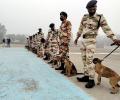
The move, which was approved by the Union home ministry, comes amid a military standoff with China in the eastern Ladakh area.
Pakistan's Climate Change Minister Musadik Malik is set to participate in the Shanghai Cooperation Organisation Civilisational Dialogue in India, a move that could signal a thaw in strained bilateral relations.

"While we're at it, we're talking about China and India are going at it pretty good on the border, as you know. It's been very nasty," Trump told reporters on Friday evening at a White House news conference.
India is set to host the SCO Civilisational Dialogue Forum in New Delhi from November 20-22, with 15 countries, including China, Kazakhstan, and Iran, confirming participation. Union Culture Minister Gajendra Singh Shekhawat expressed hope for Pakistan's attendance, emphasizing the cultural commonalities despite geopolitical differences. The forum aims to reinforce cultural relations and showcase India's rich civilisational history.
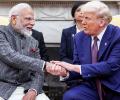
India has firmly rejected any involvement of a third party in its border dispute with China, declining an offer of mediation from US President Donald Trump. Foreign Secretary Vikram Misri emphasized India's commitment to resolving bilateral issues through direct dialogue, stating that New Delhi has always maintained a bilateral approach in dealing with such matters. This stance underscores India's position that the border dispute with China should be addressed through direct negotiations between the two countries.

China has announced new export controls on key machinery, including tunnel boring machines, walking excavators, and dredger components, citing national security. These restrictions, effective November 18, could significantly impact India's infrastructure projects, such as metro systems and high-speed rail lines, as China has previously limited such exports to India.
India's dual pursuit of a robust strategic partnership with Washington and a pragmatic, tension-management policy with Beijing represents the essence of modern multi-alignment. By embracing economic pragmatism, learning to compartmentalize political differences, and engaging in continuous dialogue, India can secure its borders, grow its economy, and contribute to a stable, multipolar Asian century, points out Ambassador Rajasekhar.

Chinese Foreign Minister Wang Yi met with National Security Advisor Ajit Doval in New Delhi, stressing the importance of respecting each other's "core interests" and implementing leaders' consensus for stable bilateral relations. Wang highlighted that India and China should view each other as partners, not rivals, and properly handle sensitive issues like the border dispute to foster cooperation and accelerate the modernisation of the Global South.
Chinese Foreign Minister Wang Yi has called on India and China to view each other as partners rather than rivals, emphasising the importance of cooperation for regional stability and development.
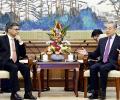
India and China held diplomatic talks in Beijing, focusing on effective border management and the resumption of cross-border cooperation and exchanges, including on trans-border rivers and the Kailash-Mansarovar Yatra. The meeting explored measures and proposals to implement decisions made during the Special Representatives (SR) dialogue in December. Both sides agreed to work together for the next SR meeting in India later this year.
National Security Advisor Ajit Doval engaged in Special Representatives talks with Chinese Foreign Minister Wang Yi in Beijing, focusing on the India-China boundary question and enhancing bilateral relations. These crucial discussions precede Chinese President Xi Jinping's anticipated visit to New Delhi for the BRICS summit, aiming to address persistent border differences and stabilise ties strained by past conflicts like the Galwan Valley clash.

India is ranked as a "Rising Contender" in AI by Boston Consulting Group (BCG), indicating high readiness but lower disruption exposure. The report highlights India's strength in its large pool of AI specialists and IT-services workforce. While not yet an "AI Pioneer," India is leveraging its talent advantage, with government initiatives like Yuva AI for ALL and IndiaAI FuturesSkills aiming to upskill citizens and broaden access to AI education. The report emphasizes that execution and talent deployment are crucial for economies to gain ground in AI.

Greeting the jawans on the occasion, the prime minister said their devotion to duty in the remote icy heights, is enabling the strength of the nation, and securing the future and the dreams of 125 crore Indians,
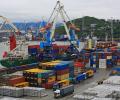
The White House has launched a major crackdown on the 'Great Transhipment Scam', accusing India and over 40 other nations of helping Chinese exporters bypass US tariffs by misrepresenting the origin of goods. The US plans to use AI-driven monitoring and anti-transhipment clauses in future trade agreements to strengthen enforcement.
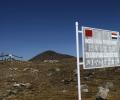
Two Arunachal Pradesh youths from the state's Anjaw district have not returned home from August this year when they had set out in search of medicinal plants near the state's border with China.

'All these reports and announcements by the US seem like attempts to gain a lever in trade deal negotiations with India.'

'Xi is conveying that China is a pre-eminent power, and India should modulate its actions or approaches accordingly.'

Chinese President Xi Jinping's first visit to India in seven years for the BRICS Summit and bilateral talks with Prime Minister Narendra Modi is set to address crucial aspects of India-China relations, including trade, investment, and persistent border tensions.
